
CLEAN ROOM VALIDATION
Introduction
Walk into a pharmaceutical manufacturing unit or a hospital operation theatre and everything looks spotless. Shiny floors. Filtered air. Staff in protective suits. It feels safe. Controlled. Precise.
But here is the truth: appearances mean nothing without proof.
That proof comes from CLEAN ROOM VALIDATION. It is the process that confirms your cleanroom is not just built correctly, but performs according to strict standards every single day. In industries where one microscopic particle can ruin a product or risk a patient’s life, CLEAN ROOM VALIDATION is not optional. It is foundational.
If you are running a pharmaceutical facility, hospital clean zone, biotech lab, or electronics plant, this is something you cannot afford to misunderstand.
What is CLEAN ROOM VALIDATION?
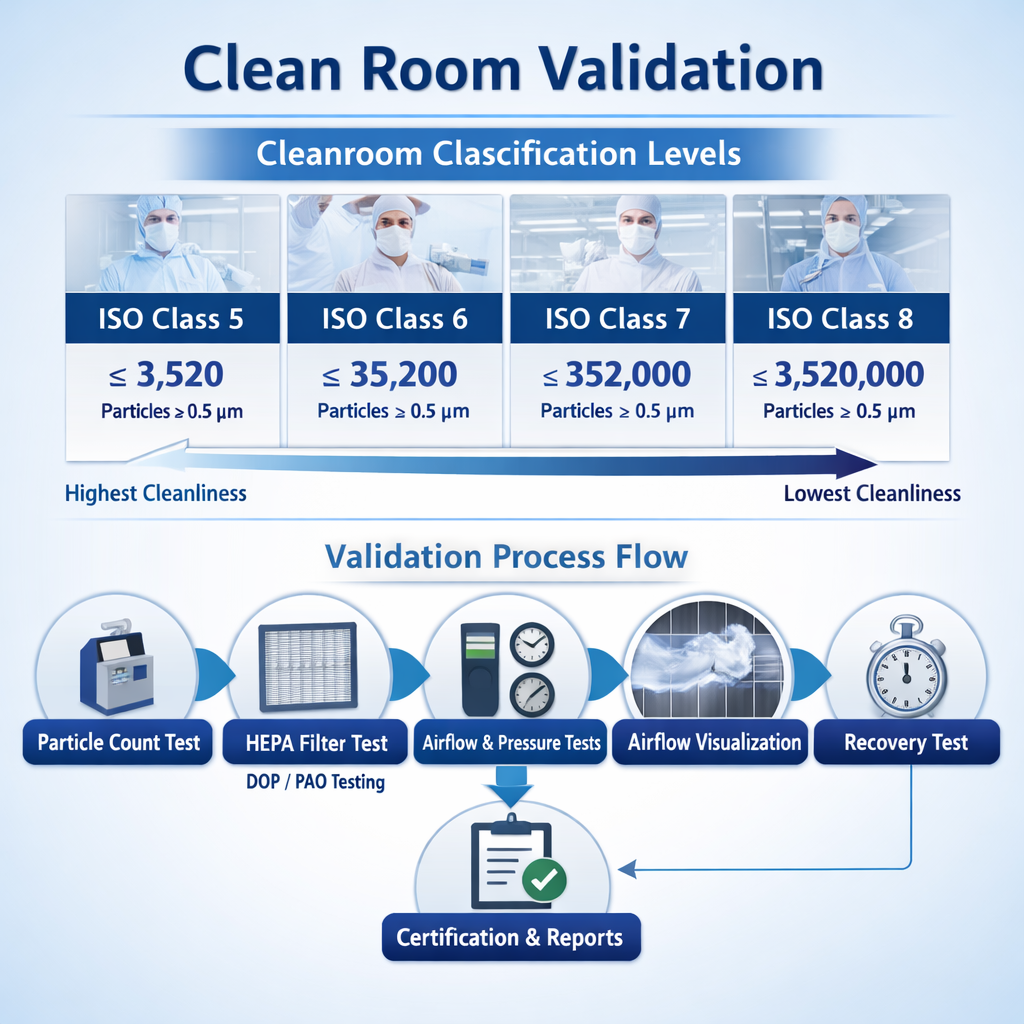
CLEAN ROOM VALIDATION is the documented process of proving that a controlled environment meets ISO and GMP standards for cleanliness, airflow, pressure, and environmental control.
A cleanroom is built to prevent contamination. But building it right is not enough. Over time, systems shift and filters degrade. CLEAN ROOM VALIDATION confirms that everything is still working exactly as it should. But design is theory. Validation is proof.
This process measures and confirms:
- Airborne particle levels
- HEPA filter integrity
- Airflow velocity and patterns
- Pressure differentials
- Temperature and humidity stability
Without CLEAN ROOM VALIDATION, you are relying on assumption. And assumption is expensive.
Why Validation is Non-Negotiable
Let us say you manufacture sterile injectables. One unnoticed contamination event could trigger a recall. Recalls do not just cost money. They destroy trust.
That is why pharmaceutical clean room validation and hospital clean room validation exist. They protect product quality and human safety.
Why CLEAN ROOM VALIDATION Matters Across Industries
Different industries. Same principle. Control the environment or risk everything.
Pharmaceutical Clean Room Validation
Pharmaceutical clean room validation ensures compliance with GMP standards. Regulatory authorities demand documented evidence that:
- Air meets ISO classification limits
- HEPA filters are leak-free
- Airflow maintains sterility
- Recovery time after contamination is within limits
GMP clean room validation is especially critical for sterile drug production, vaccines, and injectable medicines.
Miss one parameter and the entire batch can be rejected.
Hospital Clean Room Validation
Hospitals depend on hospital clean room validation in operation theatres, ICUs, and sterile storage areas.
If pressure differentials fail, contaminated air can enter sterile zones. In surgery, that is unacceptable.
Here, validation protects patients, not just products.
ISO Cleanroom Validation
ISO cleanroom validation follows ISO 14644 standards. Cleanrooms are categorized from ISO Class 1 to ISO Class 9 according to the number of particles present in the air. Electronics manufacturing, semiconductor facilities, and biotech labs rely heavily on ISO cleanroom validation to ensure precision production.
In short, validation protects performance, compliance, and reputation.
CLEAN ROOM VALIDATION Testing: What Actually Happens?
Let us break down the cleanroom testing and validation process step by step.
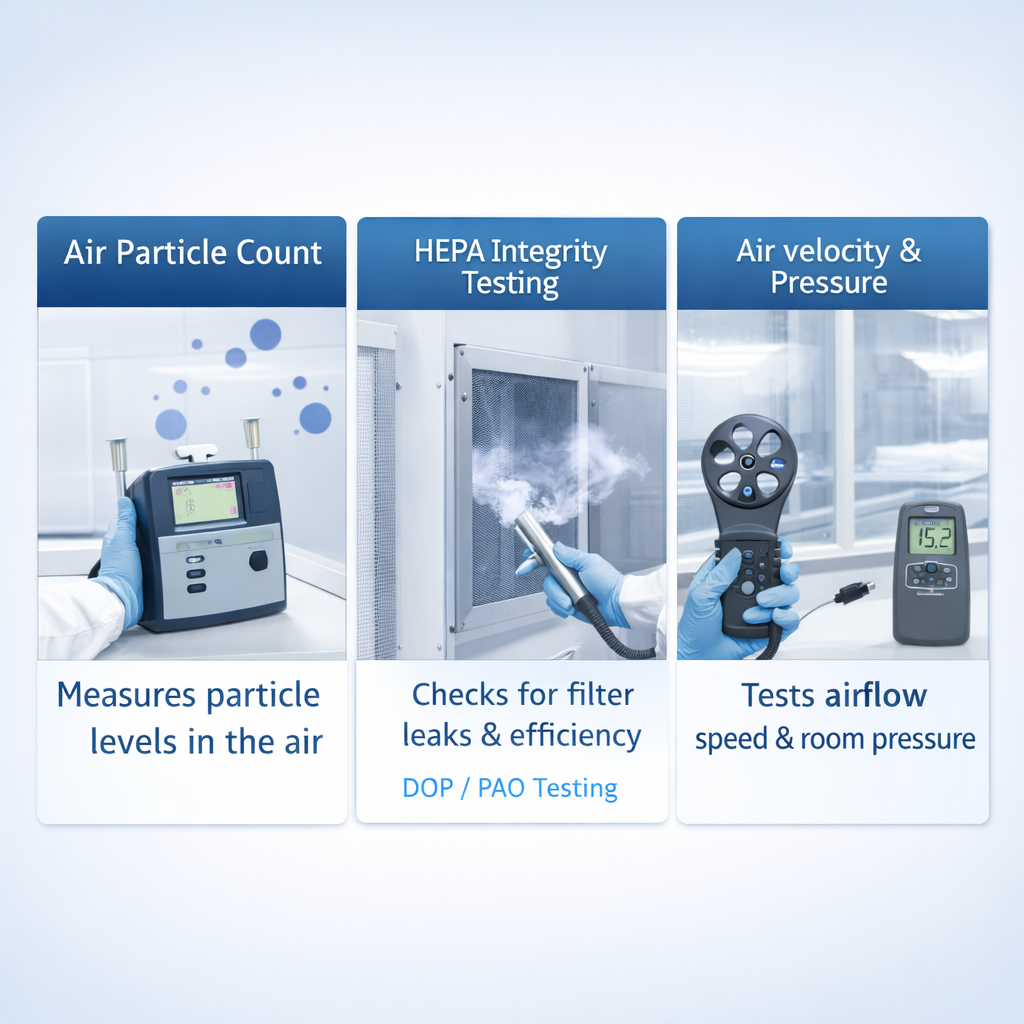
- Air Particle Count Test
- This test measures airborne particles to verify ISO classification.
- A calibrated particle counter samples air at multiple locations. The results determine whether the cleanroom meets required standards.
- No guessing. Just numbers.
- HEPA Filter Integrity Test (DOP/PAO)
- HEPA filters are the heart of a cleanroom. If they leak, contamination enters.
- During CLEAN ROOM VALIDATION, a DOP or PAO test identifies even microscopic leaks in filter seals and frames.
- You cannot see these leaks. But the test will find them.
- Airflow Velocity and CFM Measurement
- Airflow velocity ensures laminar flow systems function properly.
- Too slow? Contaminants settle.
Too fast? Turbulence increases risk. - Precise airflow measurement keeps everything balanced.
- Airflow Pattern Visualization (Smoke Study)
- Smoke studies visually confirm airflow direction.
- This is often used in pharmaceutical clean room validation to ensure sterile airflow over critical areas.
- If smoke swirls backward, you have a problem.
- Recovery Test
- This test measures how quickly a cleanroom returns to acceptable particle levels after simulated contamination.
- A slow recovery time indicates poor ventilation efficiency.
- Each of these tests forms the backbone of professional clean room validation services.
Cleanroom Qualification Services: IQ, OQ, PQ
Validation is not random testing. It follows structured qualification stages.
Installation Qualification (IQ)
Confirms that equipment and systems are installed as per design specifications.
Operational Qualification (OQ)
Tests the system under operational conditions to verify performance.
Performance Qualification (PQ)
Confirms long-term consistency during actual production conditions.
Cleanroom qualification services ensure these three stages are properly executed and documented.
Without documentation, auditors will not accept compliance claims.
Choosing the Right Clean Room Validation Company
Here is where many businesses make a mistake.
They look for the cheapest clean room validation company.
That is short-term thinking.
When selecting a cleanroom certification company, consider:
- Industry experience
- Calibrated instruments
- Knowledge of ISO and GMP regulations
- Detailed reporting
- On-site technical support
If you are searching for clean room validation services India or clean room validation service in India, verify that the provider understands both local and international compliance standards.
Clean room validation in India is growing rapidly, especially in pharmaceutical and medical device sectors. Regulators are stricter than ever.
Choose expertise over discounts.
Common Mistakes in CLEAN ROOM VALIDATION
Let us be blunt.
Treating It as a One-Time Activity
CLEAN ROOM VALIDATION requires periodic revalidation. Filters degrade. Systems age. Conditions change.
Skipping annual testing invites risk.
Poor Documentation
A clean room test without proper documentation is useless during audits.
Ignoring Minor Deviations
Small airflow issues today can become major contamination failures tomorrow.
Real-Life Scenario: A Lesson in Overconfidence
A mid-scale pharmaceutical plant once assumed their HEPA filters were fine because “they were replaced last year.”
During routine CLEAN ROOM VALIDATION, micro-leaks were detected along filter frames.
Those tiny leaks were enough to increase particle counts beyond ISO limits.
Production was halted temporarily. But because the issue was caught early, they avoided regulatory penalties.
That is what validation does. It exposes silent risks.
CLEAN ROOM VALIDATION in India: Rising Demand
India’s pharmaceutical exports are expanding globally. With global markets comes global scrutiny.
Clean room validation services India is increasingly required for:
- Pharma manufacturing
- Biotech labs
- Hospital operation theatres
- Medical device production
International buyers demand ISO cleanroom validation and GMP clean room validation compliance.
There is no room for shortcuts anymore.
Conclusion
CLEAN ROOM VALIDATION is more than a regulatory obligation. It is your safety net.
It confirms your environment performs as designed. It protects patients. It safeguards product integrity. It shields your reputation.
Whether you need pharmaceutical clean room validation, hospital clean room validation, or full cleanroom certification service support, the goal remains simple: verified performance and documented compliance.
If your facility has not undergone CLEAN ROOM VALIDATION recently, do not wait for an audit to expose weaknesses. Act now. Partner with experienced cleanroom validation services and ensure your cleanroom truly lives up to its name.
FAQs
What is cleanroom validation?
Cleanroom validation is the process of testing and documenting that a cleanroom meets ISO and GMP environmental standards.
How often should CLEAN ROOM VALIDATION be done?
Most facilities conduct annual validation, though high-risk environments may require more frequent testing.
What does clean room validation testing services include?
It includes particle count testing, HEPA integrity testing, airflow measurement, smoke studies, and recovery testing.
Why is GMP clean room validation important?
GMP clean room validation ensures pharmaceutical and medical products are manufactured in contamination-controlled environments that meet regulatory standards.
How do I choose a clean room validation company?
Select a provider with proven experience, calibrated equipment, regulatory expertise, and comprehensive reporting capabilities.